I have never met another Satanist who didn’t listen to the band Ghost. It’s almost like a requirement or something. Every time I meet someone who outs themselves as a Satanist to me, Ghost – and music in general – is one of the first topics of conversation. It’s not very surprising, considering Satanism and music have a long-standing association. Heavy metal and rock and roll musicians and songwriters are often accused of Satanism. Some of them – such as bands like Ghost, Behemoth, and Cradle of Filth – lean into that association in their lyrics and aesthetic, to their critics’ revulsion and their fans’ unholy delight.
Musicians and songwriters outside of metal are also known to lean into Satanic imagery and aesthetics. Lady Gaga got a lot of criticism when “Born This Way” came out for using what many Christians misinterpreted as Satanic imagery in the music video (although, let’s be honest, it was because she was loudly throwing her support behind the LGBTQ community as if we didn’t already know she was an activist). In “Montero (Call Me By Your Name),” Lil Nas X descends into hell on a stripper pole, gives the devil a lap dance, and overthrows Satan after struggling with his hatred for himself and his Christian upbringing. When Evangelicals predictably lashed out against the imagery and the story that called them on their bull shit, Lil Nas leaned even further into it and released his limited edition “Satan shoes,” which hilariously made those same Evangelicals foam even more at the mouth. This past year, Sam Smith also got accused of Satanism for his Grammy performance with Kim Petras, during which he wore red pleather and plastic horns on a tophat – in my opinion bringing to mind that scene from Hocus Pocus where the witches mistook a dude dressed in red spandex for the devil. The people who lost their shit over it were just as silly.
Unsurprisingly, every musician, singer, and songwriter I just listed are involved in some way in the LGBTQ community.
But the association with Satanism and music isn’t a recent thing. Composers and musicians have been exploring the concept of the devil for centuries if not millennia. One of my favorite classical music compositions is Modest Mussorgsky’s “Night on Bald Mountain.” The rendition of the composition most people are familiar with is Leopold Stokowski’s interpretation shown on Fantasia, which depicts the Slavic devil/god Chernobog throwing a nice little party for his demon buddies while the townspeople at the foot of the mountain sleep. While Chernobog isn’t exactly the devil from Christian mythology, he is a similar character in Slavic mythology.
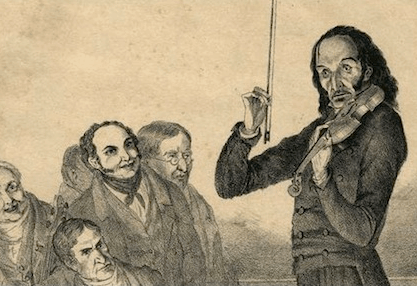
Another example of Satanism and classical music intertwining is Niccolo Paganini. He was an Italian violinist and composer and a celebrated virtuoso. He was so good at what he did, a Faustian legend that he had sold his soul to gain his prowess was fairly widespread. There are no actual photographs of him that I could find, but most illustrations and portraits I’ve seen of him suggest he was a gaunt man with abnormally long fingers – kind of spooky-looking – and that probably added fuel to the legend. The fact that he allegedly turned away the priest who came to pray over him as he was dying only solidified that reputation.
As widespread as Paganini’s legend was, most people today think of Robert Johnson when asked about musicians who might have sold their souls. Born nearly 130 years after Paganini, Johnson was a Mississippi Delta blues guitarist and songwriter who enjoyed a brief moment of popularity before he mysteriously died at the ripe old age of 27. When he first started out, he wasn’t nearly as popular or as well-known as he is today. Turns out, practice will do that for you. Practicing in a graveyard and singing songs about walking side-by-side with the devil will give you a reputation for selling your soul.
Johnson’s music revived in popularity in the 1960s, long after he was already dead. Around that time, rock and roll – largely influenced by the blues – began to surge in popularity as well. I don’t think it’s a coincidence that ever since Johnson’s music was rediscovered, rock and metal musicians have been commonly associated with Satanism.
Ever since music was created, music has been an art form people love to use to tell stories and explore mythology. The devil is a mythological character that people find both fascinating and revolting – even Evangelicals who supposedly can’t stand him or his followers. It only makes sense that musicians would want to sell their souls.
 Playing With Demons